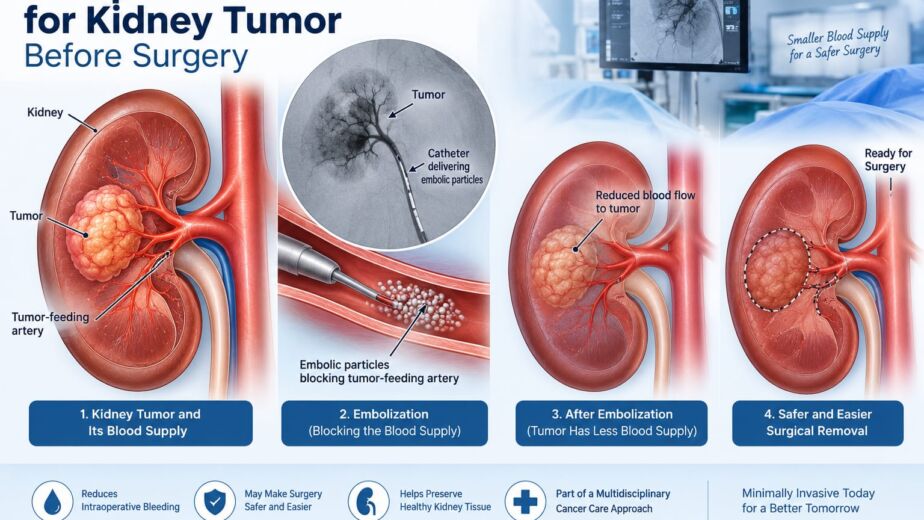
Being diagnosed with a kidney tumor can be worrying, especially when the first thought is, “Will I have to lose my kidney?” The good news is that kidney tumor treatment does not always require removal of the entire kidney. Depending on the size, location, type and stage of the tumor, as well as your overall health and kidney function, kidney-preserving options may be available.
Modern kidney tumor treatment includes several approaches. These may include active surveillance for selected small tumors, surgery that removes only the tumor, and minimally invasive treatments such as thermal ablation for appropriately selected patients. The right approach depends on an individual medical evaluation rather than the diagnosis alone.
Does Every Kidney Tumor Require Removal of the Entire Kidney?
No. Removing the entire kidney, known as a radical nephrectomy, is sometimes necessary, but it is not the only treatment option.
For certain localized kidney tumors, doctors may consider a kidney-preserving approach. The goal is to control or remove the tumor while retaining as much healthy kidney tissue as safely possible.
This is particularly important because preserving kidney function can be beneficial over the long term. The treatment decision may depend on:
- Tumor size and location
- Whether the tumor has spread
- Function of both kidneys
- Patient’s age and general health
- Relationship of the tumor to major blood vessels and the urinary collecting system
- Whether surgery or ablation is technically suitable
Therefore, kidney tumor treatment should always be individualized.
What Is Nephron-Sparing Surgery?
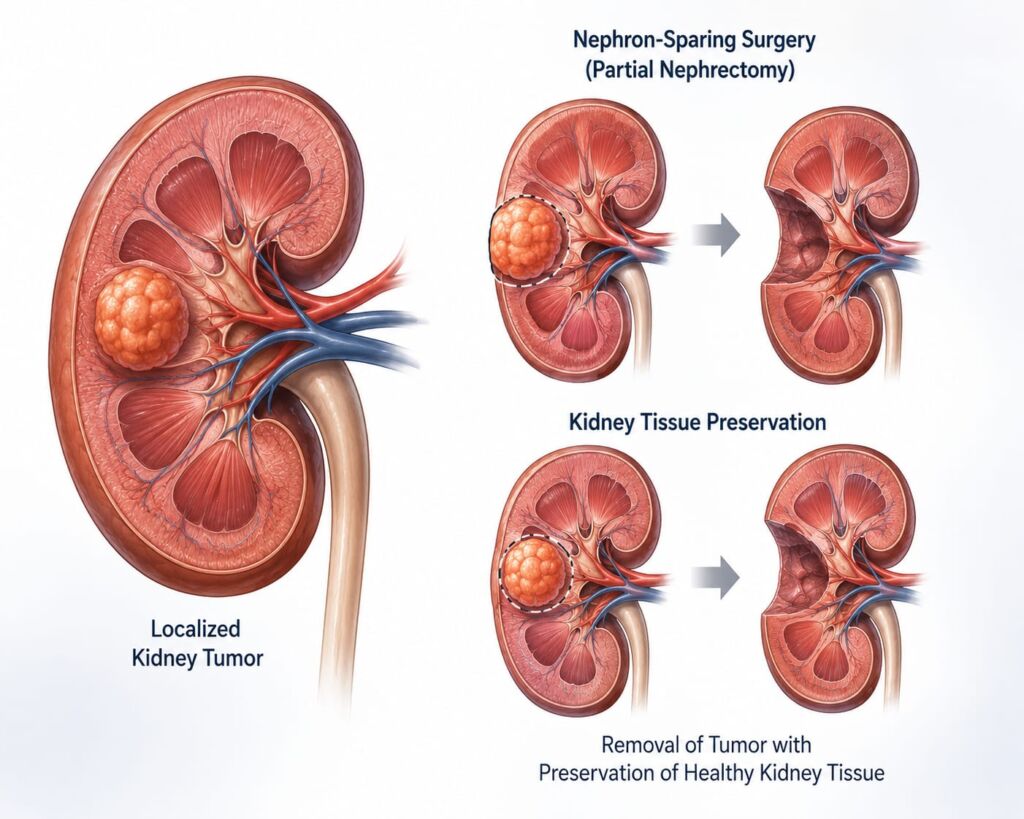
Nephron sparing surgery is a kidney-preserving surgical approach in which the surgeon removes the tumor while leaving as much functioning kidney tissue as possible.
One common form of this treatment is partial nephrectomy. Instead of removing the entire kidney, the surgeon removes the tumor with a margin of surrounding tissue and preserves the remaining portion of the kidney.
For appropriately selected localized kidney cancers, partial nephrectomy can provide effective cancer treatment while helping preserve kidney function. However, it is not suitable for every tumor. A tumor’s size, position and complexity are important factors when deciding whether this approach is technically possible.
What Is Kidney-Sparing Surgery?
Kidney sparing surgery focuses on treating the tumor without unnecessarily removing the entire kidney.
For example, a patient with a small, localized tumor in a favorable location may be considered for partial nephrectomy. In some situations, partial nephrectomy robotic surgery may be used as a minimally invasive surgical approach.
The objective is not simply to avoid removing the kidney. The priority is to achieve appropriate tumor control while preserving healthy kidney tissue whenever it can be done safely.
Can a Kidney Tumor Be Treated Without Surgery?
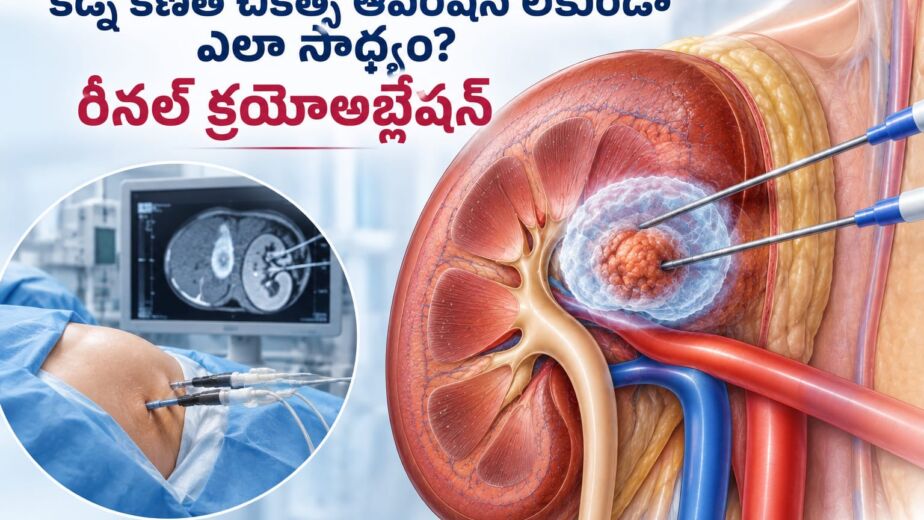
In selected patients, a kidney tumor may be treated using a minimally invasive procedure called thermal ablation.
During thermal ablation, imaging is used to guide specialized probes directly into the tumor. Depending on the technique, extreme cold or heat is used to destroy the targeted tumor tissue.
Cryoablation is one such technique. It uses freezing temperatures to destroy tumor cells and may be considered for certain small kidney tumors, particularly in patients for whom surgery may carry greater risks.
However, this does not mean every kidney tumor can be treated without surgery. Tumor size, location, proximity to important structures, kidney function and the patient’s overall health all influence whether ablation is appropriate.
What Are the Signs of a Kidney Tumor?
Many kidney tumors do not cause obvious symptoms in their early stages and may be discovered during imaging performed for another reason.
Possible signs of kidney tumor can include:
- Blood in the urine
- Persistent pain in the side or lower back
- A lump or swelling in the abdomen or side
- Unexplained weight loss
- Persistent tiredness
- Fever without an obvious cause
These symptoms do not necessarily mean that a person has kidney cancer. Other urinary and kidney conditions can cause similar symptoms. If symptoms persist, appropriate medical evaluation is important.
How Is the Right Renal Tumor Treatment Chosen?
There is no single renal tumor treatment that is appropriate for everyone.
A specialist will usually consider imaging such as CT or MRI along with kidney function and other clinical information. The location and size of the tumor are particularly important when deciding between surgery, ablation, surveillance or other treatment approaches.
For example, a small tumor located away from critical structures may be technically suitable for ablation or partial nephrectomy. A larger or more complex tumor may require a different approach.
The decision should therefore be based on the complete clinical picture rather than choosing a treatment solely because it is less invasive.
Can Removing a Kidney Tumor Preserve Kidney Function?
In appropriate cases, yes. The purpose of kidney-preserving treatment is to remove or destroy the tumor while retaining healthy functioning kidney tissue.
For some patients, kidney sparing surgery can preserve more kidney tissue than complete kidney removal. For selected tumors, minimally invasive ablation may provide another kidney-preserving option.
However, preserving the kidney is not always possible or appropriate. If the tumor is extensive, difficult to remove safely, or has characteristics that require a more aggressive treatment, complete kidney removal may still be recommended.
The priority should always be safe and effective tumor management while preserving kidney function whenever reasonably possible.
When Should You See a Kidney Tumor Specialist?
If imaging has identified a kidney mass or you have been diagnosed with a kidney tumor, discuss the findings with an appropriate specialist before deciding on treatment.
Ask about:
- The size and location of the tumor
- Whether it appears localized
- Whether a biopsy is recommended
- Your kidney function
- Whether partial nephrectomy is possible
- Whether thermal ablation or cryoablation is appropriate
- The advantages and limitations of each option
- The expected follow-up after treatment
A second opinion can also be useful when you want to understand whether a kidney-preserving approach is feasible in your specific situation.
What Is the Takeaway?
A kidney tumor diagnosis does not automatically mean that the entire kidney must be removed. Depending on the tumor and the patient’s individual circumstances, treatment may include surveillance, partial nephrectomy, other forms of nephron sparing surgery, or minimally invasive ablation.
The goal of kidney tumor treatment should be to manage the tumor effectively while preserving healthy kidney tissue whenever it is medically and technically appropriate.
If you have been diagnosed with a kidney tumor, don’t assume that complete kidney removal is your only option. A specialist can review your scans, kidney function and overall health to determine whether a kidney-preserving treatment may be suitable for you.
Have you been diagnosed with a kidney tumor?
Consult Dr. Ram Kishore Gurajala to discuss your imaging, treatment options and whether a minimally invasive kidney-preserving approach may be appropriate for your condition.
Frequently Asked Questions About Kidney Tumor Treatment
1. Can a kidney tumor be treated without removing the entire kidney?
Yes, in selected patients. Depending on the tumor’s size, location, stage and the patient’s kidney function, options such as partial nephrectomy or thermal ablation may allow the tumor to be treated while preserving healthy kidney tissue.
2. What is nephron-sparing surgery for a kidney tumor?
Nephron sparing surgery is a kidney-preserving procedure in which the surgeon removes the tumor while keeping as much healthy kidney tissue as possible. Partial nephrectomy is a common example of this approach.
3. What is the difference between partial and radical nephrectomy?
A partial nephrectomy removes the kidney tumor and preserves the remaining healthy portion of the kidney. A radical nephrectomy removes the entire affected kidney. The appropriate approach depends on the tumor and the patient’s individual condition.
4. Can a kidney tumor be treated without surgery?
Some small, localized kidney tumors may be suitable for thermal ablation, including cryoablation. This is a minimally invasive treatment that uses image guidance to place probes into the tumor and destroy the targeted tissue. It is not suitable for every tumor.
5. What is kidney-sparing surgery?
Kidney sparing surgery aims to treat a kidney tumor while preserving functioning kidney tissue. Partial nephrectomy is one of the main kidney-preserving surgical approaches used for appropriately selected tumors.
6. What factors determine the best kidney tumor treatment?
Doctors consider the tumor’s size, location, stage and relationship to nearby structures, as well as kidney function, age, overall health and previous medical conditions. These factors help determine whether surgery, ablation, active surveillance or another treatment is appropriate.
7. Is kidney tumor treatment always necessary?
Not necessarily. Some small kidney masses may be monitored through active surveillance, particularly in carefully selected patients. Other tumors may require active treatment. The decision should be made after evaluating the tumor and the patient’s overall health.
8. Can kidney-preserving treatment completely cure kidney cancer?
Kidney-preserving treatments can provide effective treatment for selected localized kidney cancers, but the expected outcome depends on the tumor type, stage, treatment method and individual patient factors. Regular follow-up after treatment is important.